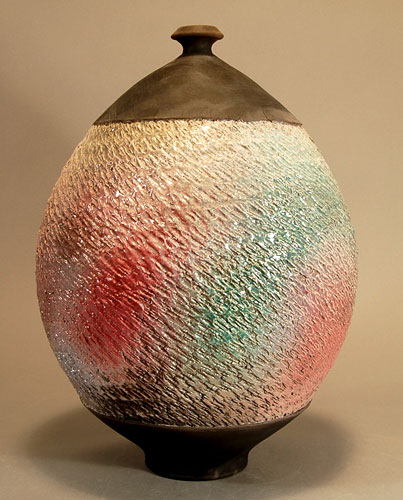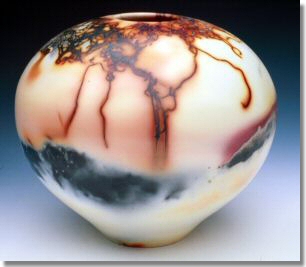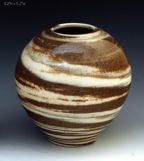
NERIAGE
AND NERIKOMI AND MISHIMA AND OTHER HIGH FIRED TECHNIQUES
NERIAGE - Neri
is a root word meaning "to mix" and age is a root word meaning to "pull up."
This refers to the pulling up action in
throwing clay on a wheel, hence neriage refers to wheel work with colored
clays. Functional, water tight.
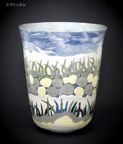
NERIKOMI
- Komi means "to press into," as in pressing clay slabs into a mold.
Nerikomi thus means hand-building with colored clay, which in Japan I guess
usually meant mold work. It has been expanded to include other methods of
hand-building."
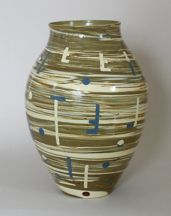
Neriage and nerikomi both use either
naturally occurring colored clays or light-colored clays that are
specifically stained to satisfy the artist's color requirement. Neriage, or
agateware, is done by laminating different colored clays together and
throwing them on a wheel to develop a swirling and spiraling blend of the
clays.
Objects made this way can be left with the
swirl pattern, or altered by various forms of cutting the surface, with
fluting and faceting. Balls of laminated clays are best left covered in a
plastic sheet so amelioration can take place.
Cutting across the grain of laminated clays
will expose an infinite variety of random patterns. The type of pattern can
be controlled both by the thickness of the layers and by how the laminations
are placed when thrown on the wheel. If they are vertical to the wheel head,
they likely will produce fine, lacy patterns. If they are placed
horizontally, much bolder patterns can be expected. If placed diagonally, a
combination of both bold and lacy patterns might be expected.
 MISHIMA
-
MISHIMA ceramics comes from the Japanese
Island of Mishima, but it was originally transported from Korea around
the 16th century. This surface design technique is a way of drawing by
inlaying a slip or soft clay of contrasting color or colors into lines or
shapes incised in leather-hard clay. MISHIMA
-
MISHIMA ceramics comes from the Japanese
Island of Mishima, but it was originally transported from Korea around
the 16th century. This surface design technique is a way of drawing by
inlaying a slip or soft clay of contrasting color or colors into lines or
shapes incised in leather-hard clay.
This example has both
Neriage and Mishima work.
Functional, water tight.
WOOD FIRED
VESSELS
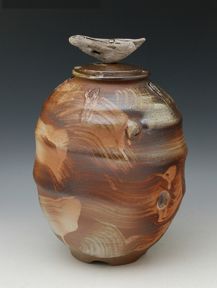
WFV (wood fired
vessels) In the case of wood-firing, the ware is painted by flames and
fly ash (ash particles resulting from the burning of the wood). Once the
kiln becomes very hot, the fly ash from the firebox that flies around the
kiln and deposits on the pieces melts and alters glazes as well as forming a
natural ash glaze and random flashing and color. It takes over a week
to complete a firing. Unlike Raku or smoked works, wood fired vessels are
high fired and watertight and functional. This is a link to the
process.
Functional, water tight.
https://www.youtube.com/watch?v=euGKzjQVXBA
Building
and firing Rose Esson Dawson's wood kiln, Westport MA 2104
|
|
Western Raku firing techniques
THE FOLLOWING
INFORMATION REFERS TO SMOKE FIRED AND PRIMITIVE TECHNIQUES
P.S. Because of
the violent firing process involved with Raku and smoke fired vessels they
are porous and must not hold water. Rarely, small white marks (pop outs)
might appear on the surface. They are small amounts of impurities in the
white clay. If they are close to the surface they might absorb moisture and
“pop”. Merely rub the spot and use a black marker the touch it up.
RAKU
FIRING
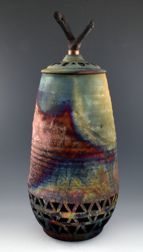
This rapid spontaneous method of glazing and firing was created in Japan in
the 16th century. Although traditional Raku glazes are soft and subdued
contemporary Raku potters use a variety of surfaces and glazes in a wide
color range, including metallic luster. In American or western Raku, the
piece is fired and then immersed in combustible material such as: wood
chips, leaves, hay etc. The chamber is then covered. The resulting oxygen
reduction atmosphere turns the unglazed clay black. The pot is then removed
and cooled. Sometimes the work plunged into cold water for quick cooling.
The word "Raku" means "felicity or happiness". In Japanese Raku, the work is
quickly fired and removed from the kiln still white hot. It is then usually
placed on a stone or the ground to cool. Very coarse clay is used and the
unglazed clay areas are usually black, red brown or white.
Traditionally the pieces fired in this way were
used in great part, for the Zen tea ceremony.
In order to withstand the thermal shock of this rapid heating and
cooling process, sand or grog (ground fired clay) is mixed with the clay
making it very porous, delicate and unsuitable for liquids or food.
The pieces created from this process are strictly aesthetic statements.
Firing in this manner leads to exciting
and variable results. Copper mattes especially will tend to loose some of
the bright color over the years, changing slightly until they acquire a
patina similar to
traditional Raku glazes (oriental) soft and subdued...They are like living
things. They mellow and age gracefully if taken proper care of. They should not be
placed in direct sunlight and the surface should only be cleaned with a soft
brush. Understanding the process and how the pottery ages
will add to your appreciation of contemporary Raku work. Glazes, after all,
are only part of the statement. The craftsmanship, form, balance,
proportion, surface and composition as well as color make the entire piece
work.
Non-functional decorative or dry storage use only
|
Sagger, Pit,
smoking and other alternative raku
techniques.
These
techniques often associated with Raku firing usually have no glaze applied but
rely on surface treatment and the fire to give them color and texture.
SAGGER FIRED, PIT FIRED, HORSE HAIR AND NAKED RAKU VESSELS
have no glaze
on the surface of the piece. These pieces are created either on the
wheel or in traditional ways, i.e. hand building: coils or pinching. As in
ancient times, some of this work is painstakingly burnished by hand with a
smooth stone or piece of metal. The process is one of intense labor.
For burnished (polished work) when close to the dry state the piece is
polished with a smooth stone, or piece of metal. This is done several times
being careful not to damage or finger print the surface. When the
piece is completely dry, It is completed using one of more of the following
techniques:
click
HERE for information on sagger firing
P.S. Because of the violent firing process involved with
these vessels, they are porous and must not hold water. Occasionally small
white marks might appear on the surface. They are small amounts of
impurities in the white clay. If they are close to the surface they might
“pop”. Merely rub the spot and use a black marker the touch it up.
|
SAGGER FIRING
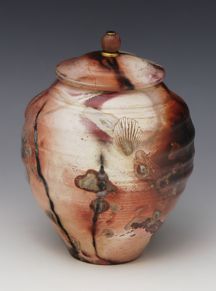
Sagger pieces are fired twice. The first is a (bisque). The second firing is
done in the Sagger, that is, a container filled with minerals, wood shavings
etc. Sometimes the piece is wrapped in seaweed or other materials to get
color. Salt is added to the Sagger along with other materials in the attempt
to get an interesting surface. The Sagger is placed in a fuel burning kiln
in my case a gas kiln and fired to about 1800 degrees. Every piece is
different Most pots are fired several times to satisfy the artist. This of
course adds to the problem of breakage. Loss and damage rates are high.
These pieces are fragile.
Non-functional decorative or dry storage use only
|
|
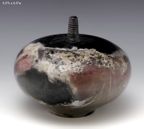 PIT
FIRING PIT
FIRING
is
the oldest known method for the firing of
pottery. Unfired pots
are nestled together in a pit in the ground
and are then
covered with combustible materials such as wood shavings, leaves,
metal oxides,
salts, sawdust and
dried manure. The top of the pit may be protected with moist clay, shards,
larger pieces of wood or metal baffles. The filled pit is then set on fire
and carefully tended until most of the inner fuel has been consumed. At
around 1,100°C (2,000°F) the maximum temperatures are moderate compared to
other techniques used for pottery. After cooling, pots are removed and
cleaned to reveal patterns and colors left by ash and salt deposits. Pots
are waxed and buffed to create a smooth glossy finish.
BARREL
FIRING
is
similar: The pots are loaded under wood and or sawdust and oxides in a
barrel. The top is lit and slowly burns down smoking the vessels inside.
They are removed when cool.
Non-functional decorative or dry storage use only
|
|
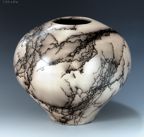
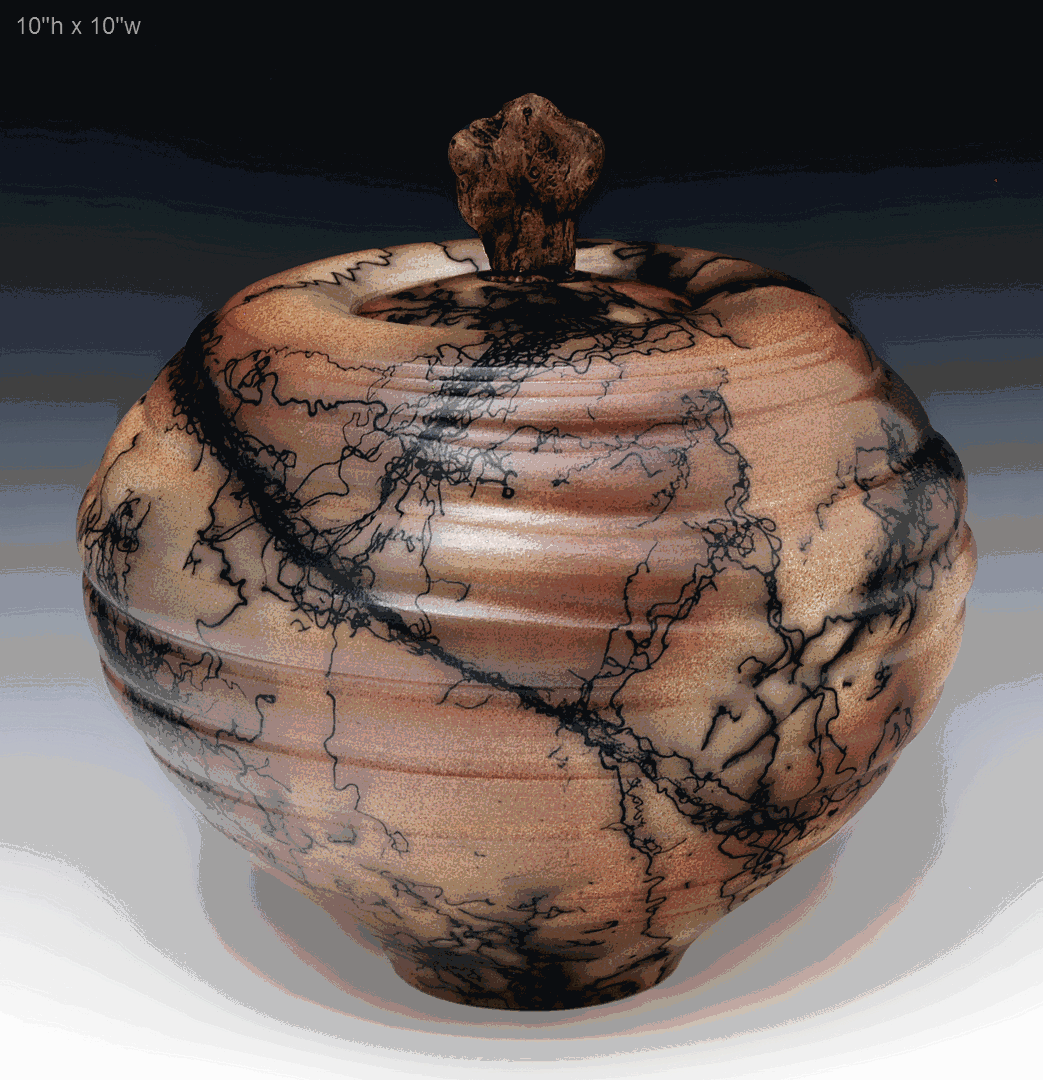
HORSE HAIR FIRING
Legend
holds that horsehair pottery was discovered by a pueblo potter whose long
hair blew against a piece of pottery she was removing from a hot kiln,
stuck, and carbonized. The result was so interesting that she duplicated it
with hair from a horse's tail.
The commonality that
links all horse hair and feather meanings in many cultures is that using or
wearing them, is a symbol for peace and tranquility. Horse hairs spiritual
meaning offers a connection with divine energy and reinforces the spiritual
power of the individual. It is believed to be a constant reminder of the
person needing to remain in harmony with nature and the higher energy found
in all elements.
My current work in this
medium combines Western Raku techniques with the application of horse hair
and other materials, such as turkey feathers and plants during the firing. Each piece of
pottery is handmade by me on the pottery wheel using white stoneware
or porcelain clay body. The bisque pots are loaded into the
Raku kiln and the temperature is brought up to approximately 1200 degrees.
The pots are then carefully removed, one at a time and the horsehair and or
feathers are
applied to the extremely hot pot. They Instantly start to vaporize on
the surface of the pot, squiggling and dancing around the surface of the
piece, painting it's image on the pot, leaving behind carbon black fossil
like marks. No two pieces are ever alike.
Non-functional decorative or dry storage use only
|
|
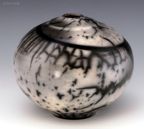
NAKED RAKU FIRING
"Naked Raku" is an interesting term for this
unglazed pot. There is no glaze applied to these pieces. This
work is usually wheel thrown from white stoneware or porcelain. After a
bisque firing, it is dipped in a special slip, glazed, dried and fired. The
slip cracks and when the piece is reduced in the reduction chamber.
The smoke enters the cracks. During cleaning the surface slip is removed
revealing the pattern beneath.
Non-functional decorative or dry storage use only
|
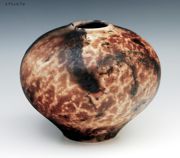
OBVARA FIRING
Obvara (Ab-Vara, or so I'm told) is a 19th-20th century Belarusian
technique involving scalding the finish on the pottery to seal the
porous surface. The bisqued piece is heated to approx 1650 F and
removed and dunked into the Obvara mixture (Flour, yeast and water) and then dunked in water to
rapidly cool the piece. The pieces range from off white to almost black
with speckles. It does a good job of sealing the surface, but they
are
still not for water or food. They, like all Smoked works, are for
decorative use only.
Non-functional decorative or dry storage use only |
The information below
referees to the origins of the word Raku and its traditional Japanese
associations.
|
In the 15th century Japanese monks came to Joseon, Korea and
stayed in a special area for Japanese traders. During their stay they
visited many Buddhist temples in Korea. The Japanese tea house is very
similar to the humble Korean style tea house of the Joseon dynasty, and
this is no doubt as a result of the influence received from Japanese
visitors to Korea such as these monks. Also many monks in Joseon fled to
Japan because the Confucian Joseon court did not support them, and tried
to remove many Buddhist temples. This two-way exchange of Korean influence
was an important influence in the development of the Japanese tea
tradition. In the 16th century,
Sen Rikyū, the Japanese tea master, was involved with the
construction of the Jurakudai and had a tile-maker, named
Chōjirō, produce hand-moulded tea bowls for use in the
wabi-styled tea ceremony that was Rikyū's ideal. The resulting
tea bowls made by Chōjirō were initially referred to as "ima-yaki"
("contemporary ware") and were also distinguished as Juraku-yaki,
from the red clay (Juraku) that they employed. Hideyoshi presented
Jokei, Chōjirō's son, with a seal that bore the Chinese character
for raku.[1]
Raku then became the name of the family that produced the wares.
Both the name and the ceramic style have been passed down through
the family (sometimes by adoption) to the present 15th generation
(Kichizaemon). The name and the style of ware has become influential
in both Japanese culture and literature.
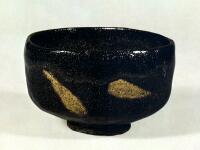
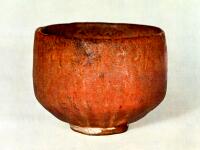
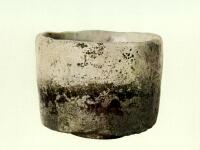
Raku ware
(楽焼
raku-yaki?)
is a type of
Japanese pottery that is traditionally used in the
Japanese tea ceremony, most often in the form of tea bowls. It
is traditionally characterized by being hand shaped rather than
thrown; fairly porous vessels, which result from low firing
temperatures;
lead
glazes; and the removal of pieces from the
kiln
while still glowing hot. In the traditional Japanese process, the
fired raku piece is removed from the hot kiln and is allowed to cool
in the open air or in a container filled with combustible material.
Raku techniques have been modified by contemporary potters
worldwide. Raku
means "enjoyment", "comfort" or "ease" and is derived from
Jurakudai, the name of a palace, in Kyoto, that was built by
Toyotomi Hideyoshi (1537–1598), who was the leading warrior
statesman of the time.
Capricious control: Sagger-Firing
- author
Dick Lehman
"Sagger" is a
term used for any structure which encloses a pot during firing: it could
refer to a large lidded pot which encloses a smaller pot. Even an
enclosure of stacked bricks with a kiln-shelf "lid" would qualify as a
"sagger". In earlier times when kilns were fired with "dirty-burning"
wood or coal, saggers were used to protect the pots from the undesirable
residue of the combustion process. With the advent of cleaner-burning
fuels, the necessity for saggers diminished. More recently potters have
again begun to use saggers - but in a way exactly opposite their
original intent: instead of using saggers to protect pots from an
outside atmosphere, potters now utilize saggers to encapsulate pots
within a very specialized atmosphere."
"My approach to
sagger firing is to wrap pots in fresh vegetation and place them in the
sagger on their sides, atop a bed of sawdust. I then cover the pot
entirely with sawdust and place the lid on the sagger. During the
firing, due to the presence of heat and pressure - and due to the
relative absence of oxygen — the vegetation turns to "activated
charcoal", and in the process, releases a film of carbon."
"When everything
works just right, the film of carbon penetrates the porous porcelain
pot. The images you see on the pots are the result of that "carbon
transfer". (Paleontologists have told me that this process is very
similar to the fossil-formation process called "Carbonization". or
"Carbon Film Transfer.)"
"This approach to
sagger firing is capricious and rather uncontrollable, and the losses
high. As in the production of fossils in nature, all the ubiquitous
variables must precisely coincide to create these marvelous sagger fired
images. Yet I find that the best results make the pursuit worth the
losses."
VESSEL CARE
Like
all fine art these vessels should not be exposed to strong light and. They should be kept
dusted and occasionally buffed (Burnished pieces) with a soft brush and a soft rag in order to
clean and refurbish the wax that has been applied to maintain the burnish.
All primitive techniques are fragile and not
waterproof. flowers or plants may be inserted in a water tight glass or
plastic container preventing contact with the fragile surface.
Follow this link to watch a
short video on burnished vessels
Burnished vessel
Video
Returns: Please contact me
via Email if dissatisfied with your purchase. You may return it for your full
purchase price. (Shipping charges are not refundable.) Buyer pays all shipping and
packing
charges. I
usually ship USPS Priority mail - insured.
I am continually updating and adding to my web site.
Check often for new additions and links.
Click
on each pot below for more information on that artist and the Japanese Tea
Ceremony.
|
|